
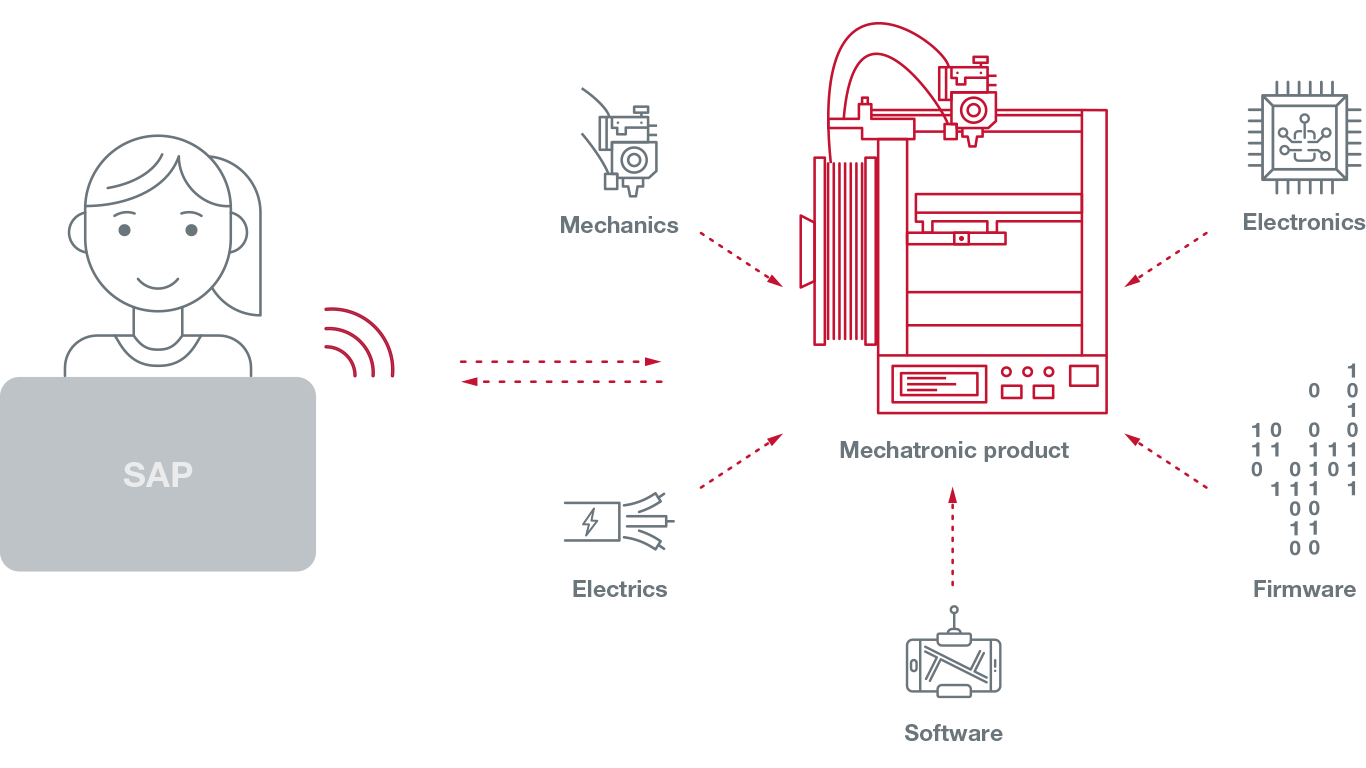
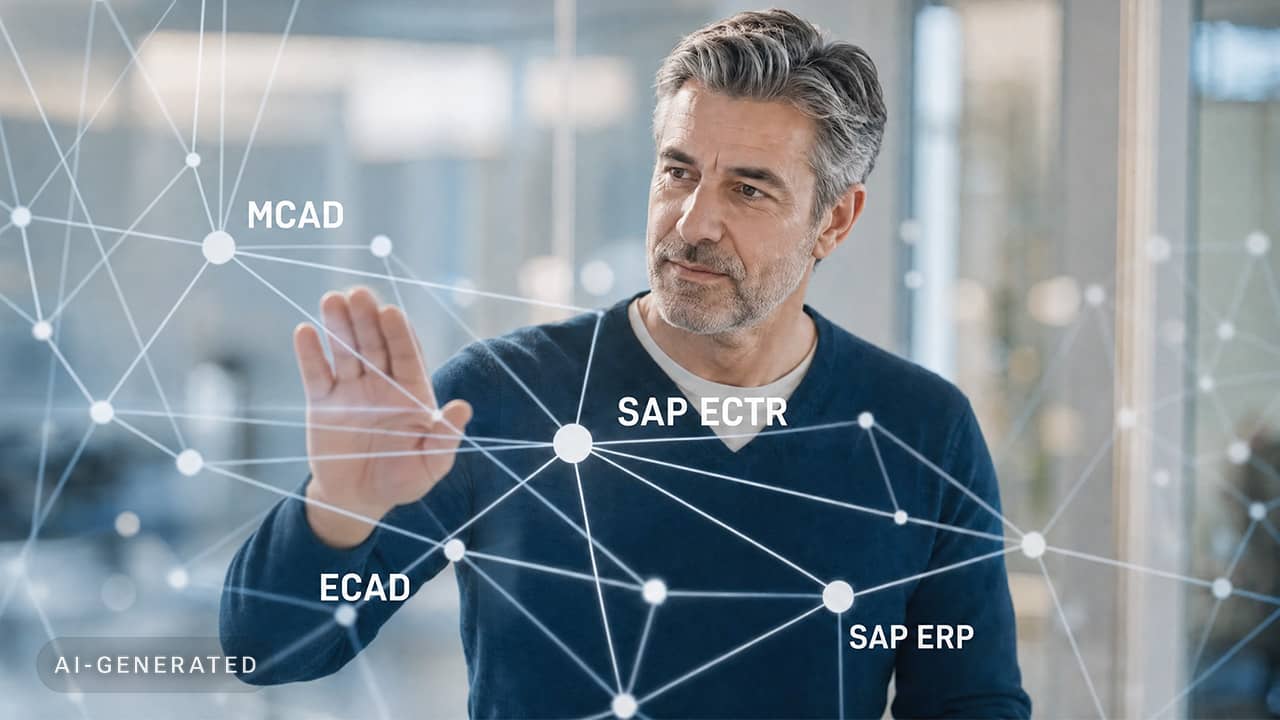
SAP Engineering Control Center | SAP ECTR, the strategic integration platform for all kinds of authoring systems, is the ideal basis for creating a holistic mechatronics solution. It integrates MCAD and ECAD systems as well as software into SAP, and provides direct access to SAP’s ERP system. This way, product data from all development disciplines is available company-wide and can be managed more easily and efficiently. Therefore, product knowledge – or better put: shared engineering context – can realize its full value where decisions are made.
The challenge
The complexity of modern products grows faster than many companies can manage. Mechanics, electronics, and software are often developed in separated systems, processes, and teams. This impairs transparency, slows down decisions, and increases the risk related to quality, costs, and time to market.
We connect engineering with business
We create a common product context across all engineering disciplines. Development data, processes, and relations are interconnected within the SAP environment and are made available for the entire company. The result is a unified view of the product reality.
A shared product context combines mechanics, electronics, and software and makes relevant product information available throughout the entire value chain.
- The work of every development discipline is based on a common product reality.
- Teams, for example, in purchasing and manufacturing access the same information basis in follow-on processes.
- Information silos are dissolved, which creates transparency for well-founded decisions.

Interconnected workflows combine engineering with business. Information and changes flow seamlessly throughout the entire product development process.
- Changes between mechanics, electronics, and software are coordinated faster.
- The teams of purchasing and manufacturing obtain released product information without delay.
- Less coordination effort and no double work shorten development cycles and change cycles.
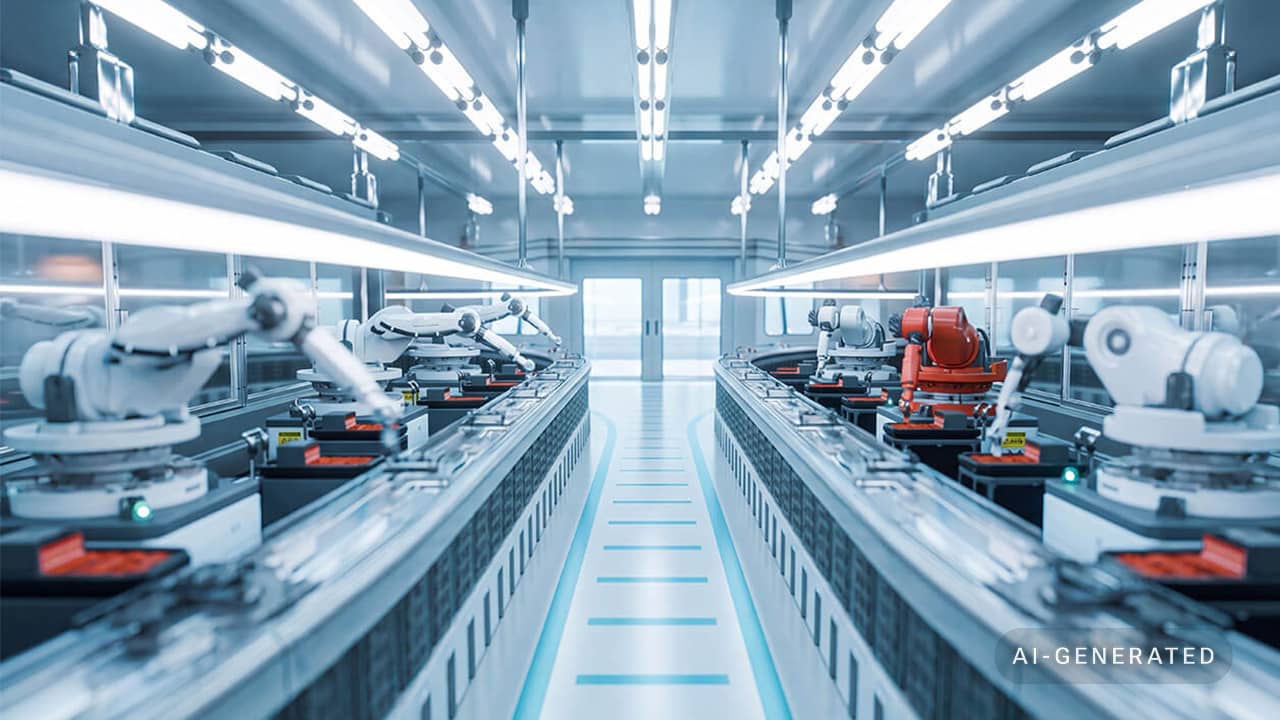
Identifying technical and business impacts early on leads to a more confident assessment of possible courses of action and to risk minimization.
- The consequences of product changes become traceable across all disciplines and processes.
- Impacts on costs, quality, and deadlines can be evaluated early on.
- Risks are identified and can be controlled in a proactive manner before they become a problem in development, purchasing, or manufacturing.
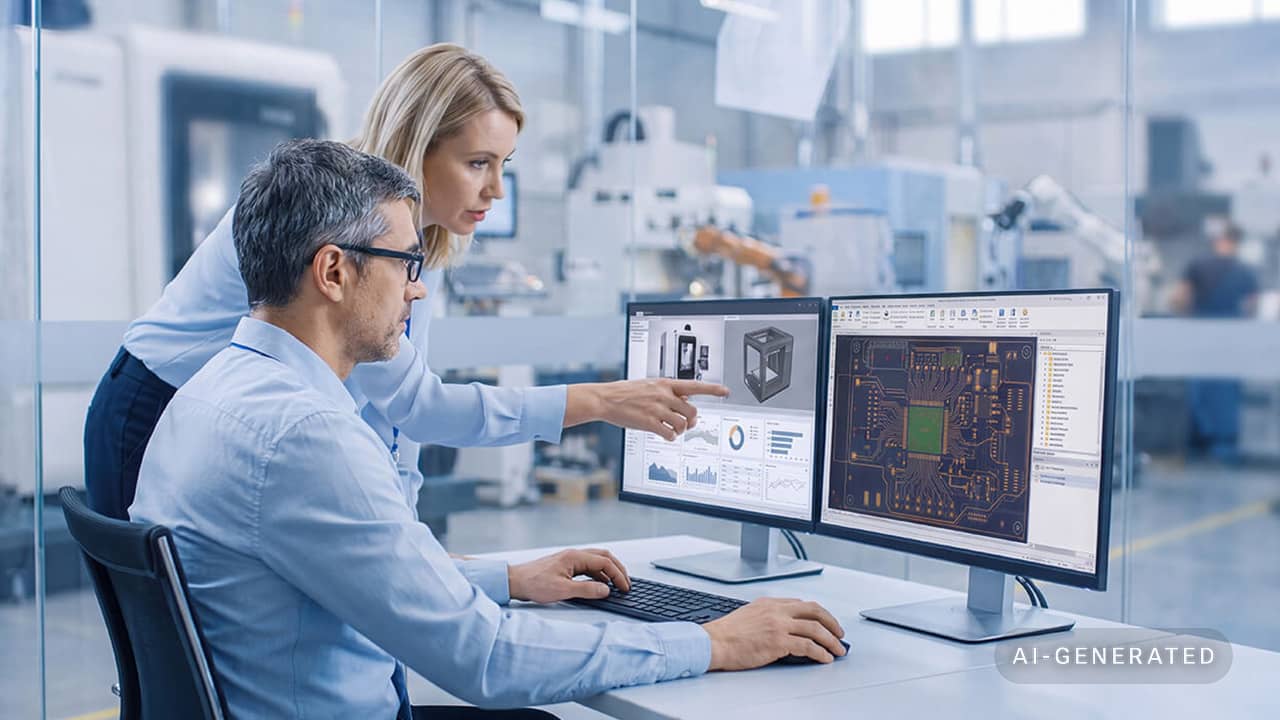
A shared product context combines mechanics, electronics, and software and makes relevant product information available throughout the entire value chain.
- The work of every development discipline is based on a common product reality.
- Teams, for example, in purchasing and manufacturing access the same information basis in follow-on processes.
- Information silos are dissolved, which creates transparency for well-founded decisions.
Interconnected workflows combine engineering with business. Information and changes flow seamlessly throughout the entire product development process.
- Changes between mechanics, electronics, and software are coordinated faster.
- The teams of purchasing and manufacturing obtain released product information without delay.
- Less coordination effort and no double work shorten development cycles and change cycles.
Identifying technical and business impacts early on leads to a more confident assessment of possible courses of action and to risk minimization.
- The consequences of product changes become traceable across all disciplines and processes.
- Impacts on costs, quality, and deadlines can be evaluated early on.
- Risks are identified and can be controlled in a proactive manner before they become a problem in development, purchasing, or manufacturing.
SAP ECTR as the basis for the mechatronic product model
FAQ
Mechatronics describes the combination of mechanics, electrics, electronics, and software in product development. The challenge lies in consolidating data and processes from different disciplines. Using SAP Engineering Control Center | SAP ECTR, companies can integrate MCAD and ECAD data in the SAP system and create a central data basis for mechatronic development. DSC Software AG developed SAP ECTR and supports companies in consistently connecting engineering data and business data.
SAP Engineering Control Center | SAP ECTR is the technological basis for an integrated mechatronic product model. As a strategic integration platform, SAP ECTR integrates authoring systems from mechanics, electronics, and software with SAP. The solution was developed by DSC Software AG and enables the integration of leading MCAD and ECAD systems. This way, product data is made available across disciplines and can be integrated into SAP processes in an efficient manner.
MCAD, ECAD, and software data is often spread across different systems, which complicates transparency and collaboration. A central management connects all engineering data and creates consistent information across different disciplines.
The approach of Integrative PLM that combines engineering with business ensures transparency regarding any kind of changes, dependencies, and impacts on the product.
The solution SAP ECTR integrates MCAD, ECAD, and software data directly in the SAP system and makes it available company-wide.
As a result, up-to-date and released product information is available to everyone involved. This reduces coordination efforts, prevents integration gaps, and accelerates decisions.
SAP ECTR enables the integration of different MCAD and ECAD authoring systems into the SAP system. Design engineers and electronic engineers continue working in their familiar development environment while documents, models, drawings, and BOMs are centrally managed in the SAP system. Together with partners, DSC Software AG provides integration interfaces to many leading MCAD and ECAD systems.
SAP ECTR was developed by DSC Software AG and is the technological foundation for the integration of authoring systems in SAP. The actual integration interfaces are often developed together with specialized partners. For example, SAP ECTR interface to EPLAN is developed and distributed by CIDEON Software & Services GmbH & Co. KG. The solution SAP ECTR interface to Zuken was developed by Zuken Inc. for the integration of its own engineering systems in SAP.
On top of the dedicated integrations for EPLAN and Zuken, the solution SAP ECTR interface to ECAD, developed by XPLM Solution GmbH, offers standardized interfaces for other leading ECAD systems such as Altium Designer, Cadence Allegro, Cadence OrCAD, Siemens Xpedition, Siemens PADS, and Siemens Capital. This way, companies can integrate even heterogeneous engineering landscapes into a consistent, SAP-based mechatronics model.
The result is a powerful partner ecosystem for mechatronic product development in an SAP environment.