Packaging has become more than a functional component of a product.
It significantly influences the following aspects:
Whether a product makes it to the market today depends not only on the product itself but also on its packaging and artwork.
Both are central parts of product development, directly influence costs, sustainability, and logistics, and are more and more in the focus of regulatory requirements. Companies need to rethink their packaging data and processes.
Modern packaging management lays the necessary foundation: It interconnects data, processes, and departments and allows for a consistent management of all packaging-relevant information.
It significantly influences the following aspects:
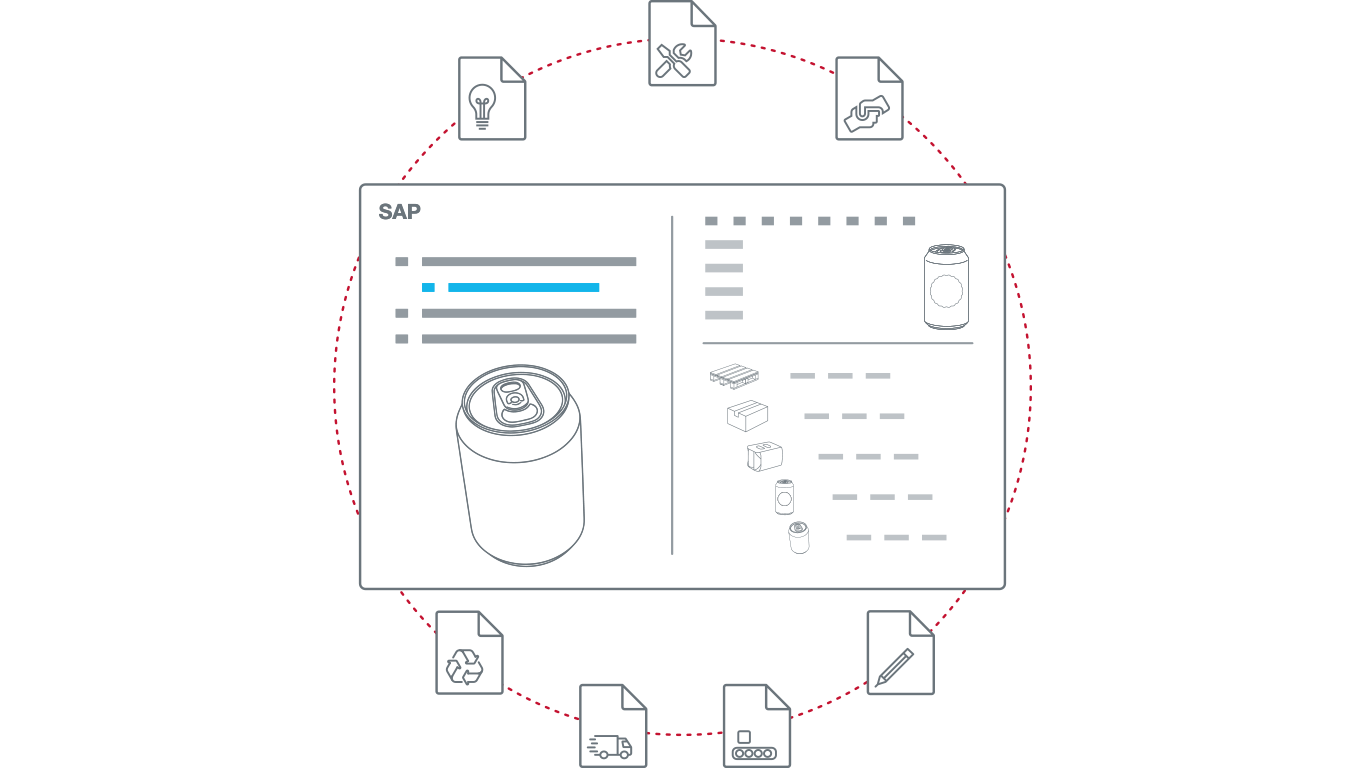
A centralized, consistent data basis is the core element of modern packaging management. SAP Engineering Control Center | SAP ECTR helps companies collect and manage all relevant packaging information in a structured way, revealing the interconnections.
Technical data, documents, and packaging structures are integrated within one end-to-end process and managed consistently – from primary to transport packaging.
This lays the foundation for an efficient and controlled management of packaging variants. Existing data can be reused systematically and developed further in a consistent manner, keeping complexity at a manageable level and ensuring data quality in the long run.
An integrated packaging and artwork management creates the necessary foundation – and delivers immediate benefits:
Artwork, packaging, and product information need to be synchronized and consistently integrated – across departments and systems. Only in this way it is possible to seamlessly connect design versions, text, regulatory content, and packaging specifications, while streamlining release processes.
The Adobe integration allows Adobe files to be stored, edited, and centrally made available for downstream processes in SAP Engineering Control Center | SAP ECTR – quickly, easily, and intuitively.
This ensures that changes remain traceable at all times, all parties work on a unified data basis, and product launches can be carried out efficiently and securely.
Packaging management encompasses the planning, development, management, and optimization of packaging throughout the entire product lifecycle.
This includes, among other things:
The goal is to make packaging processes more efficient, transparent, and sustainable.
Packaging affects central business areas such as costs, sustainability, logistics, and brand impact.
A structured approach to packaging management offers companies the following advantages:
This turns packaging into a strategic success factor.
Typical challenges are:
These factors hinder process efficiency and reliable decision-making.
The digitalization of packaging processes includes the following aspects:
These aspects enable transparent, standardized, and scalable processes.
Single Source of Truth means that all packaging data is centrally maintained in one place and made consistently available for all processes.
This prevents:
Companies benefit from higher data quality and increased data reliability.
Structured packaging management provides transparency regarding:
Benefits:
This enables companies to systematically achieve their sustainability goals.
Regulatory requirements are significantly increasing – especially regarding sustainability and recycling.
The Packaging and Packaging Waste Regulation | PPWR makes packaging a business-critical compliance issue. As an EU regulation, it is directly applicable in all member states – with clear deadlines, binding requirements, and direct impact on market access.
The pressure to act is high: As early as 2026, central provisions are becoming mandatory, with further significant requirements following from 2030 – ranging from recycling ratios and design-for-recycling to harmonized labeling and bans on certain packaging formats.
Integrated data management ensures that all relevant information is available and ready for reporting.