
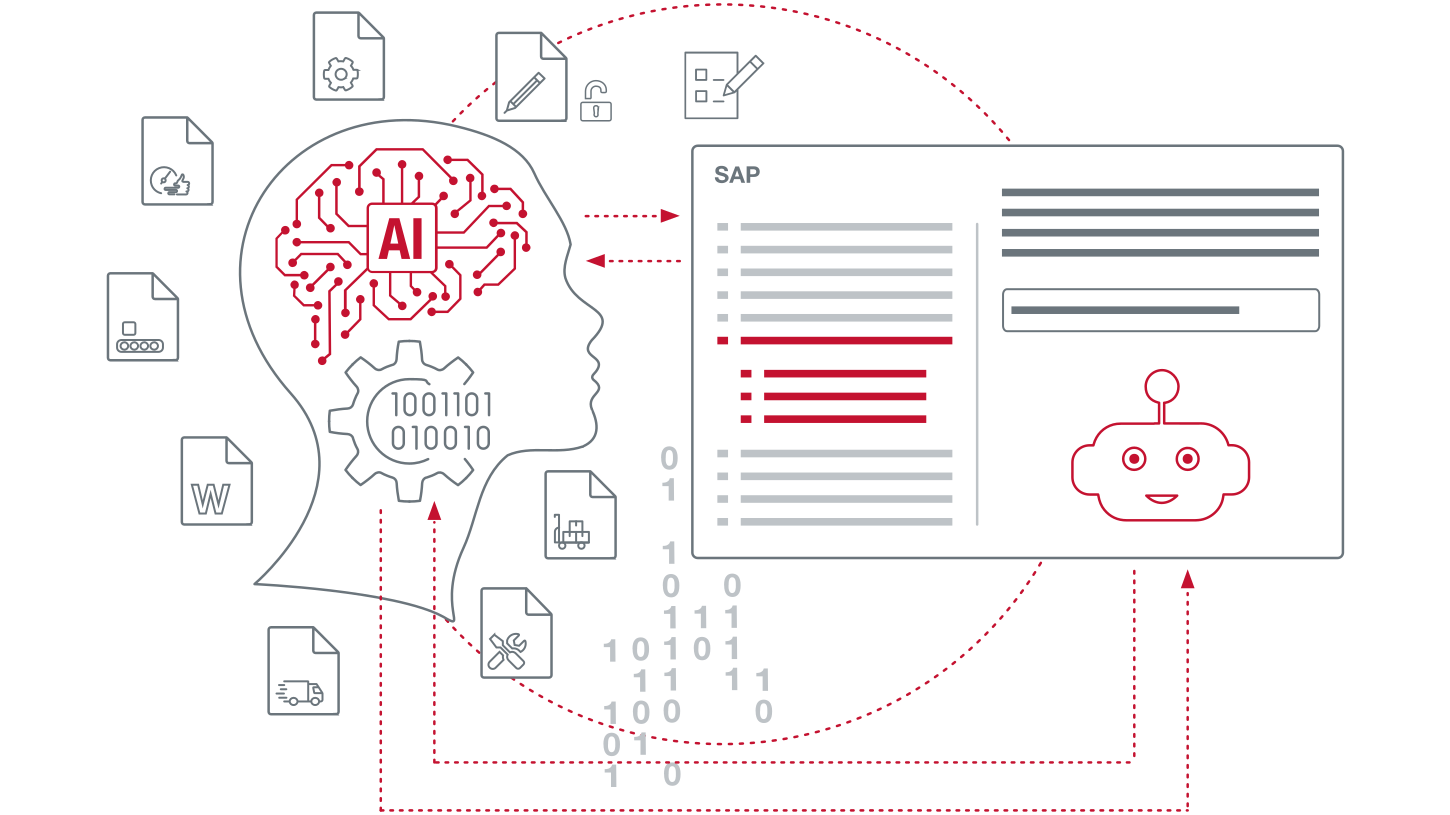
AI makes SAP system data more valuable
Industrial enterprises are faced with one of the key questions regarding their future viability and competitiveness: How can the history and the collected knowledge be saved and transformed into real value?
This is exactly what DSC's AI solutions are designed to achieve: By combining the detailed product data of SAP solutions for product lifecycle management with the crucial process data from the ERP system, the overview of products and processes as well as decision-making and automation potentials reach an entirely new dimension.

Rising to the complex challenges of the industry
Instead of banking on yet another stand-alone chatbot, DSC is opting for an open, future-proof architecture. This enables companies to integrate just those AI tools that fit their strategic goals.
Science meets real-world practice
Our AI solutions have been developed in close collaboration with universities and pilot customers and combine scientific precision with industrial reality. The result: a reliable, solid AI foundation that reduces complexity while simultaneously boosting speed and innovation.
And most importantly: It’s not just theory. Our solutions are already successfully in use.
They already support companies in taking the next step toward an intelligent, data-driven, and future-proof way of working – in a secure, scalable manner, and with new possibilities.
How AI makes your SAP processes smarter
Discover how advanced AI capabilities enhance the way you work within your SAP environment.

Become part of our co-innovation initiatives
Would you like to test AI use cases in the SAP environment early on, help shape them, or contribute your own scenarios?
If the answer is yes, we invite you to join our co-innovation projects.
FAQ
ChatGPT, Microsoft Copilot, or other AI agents do not access an SAP system directly but through a secure interface. The AI agent uses the Model Context Protocol server | MCP server to enable a standardized and controlled communication between AI and the SAP system. Methods such as Retrieval-Augmented Generation | RAG are used for this: AI specifically accesses relevant SAP data and incorporates it in its answers. This way, users can work with SAP data in natural language – while fully adhering to authorizations, security, and compliance.
Yes. DSC’s MCP server solution allows to connect any company-specific AI agent to the SAP system in a selective and secure manner. After an SAP authorization check, the AI agents automatically extract relevant information, process it, and provide it in natural language. As a result, employees can use this valuable knowledge that is available in the SAP system in a structured way.
Using our MCP server ensures that access is controlled, role-based, and compliant. Established SAP security and authorization concepts can be taken into account for sensitive data to remain protected.
RAG means that an AI model retrieves relevant data from a source – e.g., an SAP system – and uses this input to augment the generated answer. This allows users to communicate with AI in natural language, using information from the SAP system without needing to directly access the SAP system. The solutions by DSC Software AG are based on MCP and RAG methods.
SAP systems contain business-critical and highly structured information. RAG makes it possible to utilize this data for context-based AI queries, provide it in real time, and hand it over to the company-specific AI agent in a controlled manner. Once data in the SAP system changes, the updated information is immediately available for the RAG server solution. This way, it is ensured that only released data is handed over to the AI agent, adhering to the authorization concept.